Showing posts with label Food. Show all posts

Saturday, January 26, 2008

Episode 161 - Good Taste From Tradition


These photos were taken at Tai O recently.

The sticky substance in the rounded-shape baskets is another famous local produce of the village - shrimp paste. The paste was being dried under the sun before it was packed for sale. In Tai O, you can buy shrimp paste in the sauce form or in the brick form (see the shrimp blocks in the 2nd photo (taken by Gogo)).

Shrimp paste is a delicious ingredient commonly used for cooking fried vegetables or steamed pork. However, the manufacturing process of the shrimp paste could be a nuisance to many people as the unfinished paste emits repulsive smell.

Monday, January 14, 2008

Episode 158 - BBQ at the Pinewood Battery

This photo was taken at the BBQ site at the Pinewood Battery.

The facilities at the BBQ site are clean and tidy, with a number of stoves and sufficient seats and tables. Water is available nearby. There is no need to make booking - first come first served.

To have BBQ at the Pinewood Battery is a real challenge. As the site is near the top of the hill, it is not easy to carry the food, drinks, BBQ forks and the charcoal up there. My family was in fact the only party that used the site on that day.

The cold weather on that day was perhaps the other factor that deterred people from having BBQ here.

We barbecued our food by charcoal. It is not easy to ignite the traditional charcoal (the big black objects in the photo). We started the fire by using some easy-to-burn environmental friendly charcoal (the round objects in the photo). We then added traditional charcoal to the burning stove. The traditional charcoal is cheaper in price and appears to have a longer burning life than the environmental friendly charcoal.

Compare with the gas stove in the modernized BBQ corner of the estate we live, the traditional charcoal stove brought back beautiful memories and good taste - the chicken wings cooked by charcoal fire were extremely delicious!

Saturday, December 29, 2007

Episode 152 - Sunny Side Up


This photo was taken at Tai O. The red rounded objects are the village's traditional produce - preserved egg yolks.

The egg yolks are first extracted from duck eggs. They are then dried under the sun with salts. The selling price is HK$1.25 each.

The easiest way to cook a preserved egg yolk is to steam it in a rice cooker at the time when the rice is halfway done - yummy!

Saturday, June 30, 2007

Episode 127 - Food, Inns and Tradition


This photo shows part of a full Japanese traditional dinner set my family had during our 2003 Hokkaido journey.

Japanese hotels or ryokans usually provide dinners to their guests. At the time a reservation is made, a guest will be asked whether he wishes to have 1. "pure staying" - means a guest room only; or 2. "one stay one eating" - means a guest room plus dinner; or 3. "one stay two eatings" - means a guest room plus dinner and breakfast.

In western style hotels, dinners or breakfasts are usually served, in the form of buffets, in the main restaurants of the hotels. However, in traditional Japanese ryokans or hotels with Japanese style rooms, the dinners as provided can be very special.

1. The dinner time is decided by the guest;
2. It is served inside the room of the guest.
3. As you can see from the photo, a traditional dinner set is really great and you can enjoy the best food of the season in one go.

A dinner set like this is quite expensive but it is worth trying if you have not had one before.

Traditional Japanese breakfast is, however, not very much impressive, unless you love to have rice in the morning.

Wednesday, June 27, 2007

Episode 125 - Fish from the Sea

This photo was taken in Tai O in 2003.

A hawker was selling "sea fish" near the footbridge.

I did not verify the position on that day, but the "sea fish" as sold by hawkers in circumstances like this is usually a little bit tricky.

The fish as sold is sea water fish. There is no doubt of it.

What is misleading is that the "sea fish" on sale is, in most circumstances like this, raised up in a fish farm, instead of caught by fishermen in the open sea.

If you have ever tasted a fish caught in the open sea, you will not enjoy eating a farm fish again. The meat of a farm fish is simply dry and tasteless.

Having said that, it should be noted that the selling price of a farm "sea fish" is competitive - the selling price of a fish caught in the open sea is much much higher.

Tuesday, May 08, 2007

Episode 108 - Sake and Beef

Kobe is one of my favourite cities.

Many of the sake makers are in Kobe and many of the manufacturing sites are open to the public. Visitors can take a wine tasting course at some of these sites.

Kobe is also famous for beef.

There are a large number of restaurants in downtown Kobe, offering various beef menus to customers. Not all of them are good. The Kobe beef is very expensive, it is disappointed if you do not get your money's worth. I located a good restaurant in downtown after several trials. Its teppanyaki is fantastic.

I like to walk to this restaurant from the New Kobe Shinkansen Eki, as I can visit the Foreign Buildings District on the way. There are a number of traditional western houses in the district. Many of them were once consulate houses. The house in the photo was once a British Consulate.

Sunday, March 04, 2007

Episode 84 - Ginger Milk Pudding (III)

I took this photo just before the pudding is consumed.

I used fresh milk and old ginger to make this pudding - a combination that guarantees success.

Old ginger is still available in the market in this season. Its juice is hot but a small amount of it is sufficient to make a nice bowl of pudding.

I have tested different types of milk. Fresh milk (high calcium low fat) appears to be the best choice. Preserved milk is not recommended.

Sunday, January 14, 2007

Episode 64 - Ginger Milk Pudding (II)

I visited my parents yesterday and treated them with the ginger milk puddings (see a picture of the pudding here).

My father said he tried to taste this pudding when he visited Fatshan previously but he could not find the shop. He was surprised that I could make the pudding.

My parents enjoyed the puddings very much and said that's the best ginger milk puddings they have ever tasted!

I have taught my parent's Indonesian maid the method to make the pudding. Hopefully she can make the puddings for everyone's enjoyment in the next family gathering.

Thursday, January 11, 2007

Episode 63 - Ginger Milk Pudding

No photo this time (see photo in Part III) as the subject matter has been consumed.

I love eating (good food) but I seldom do any cooking myself.

Last Sunday evening, I watched a TV program on cooking at home. It's a one hour show with a lady speaking words of exaggeration and performing seemingly amateur standard cooking demonstrations. I like to watch cooking programs but I did not like this one. I was used to switching the channel as soon as I saw that lady waving a big chopper in the air.

That evening, I turned on the TV and noted that the channel I selected was showing that cooking program. I was annoyed and decided to change the TV channel as usual. Just before I pressed the remote control button, I got a feeling that the lady was very confident at this part of the show. I withheld my desire to switch channel and continued to watch the show. The lady then gave detailed instructions and demonstration on how to make a ginger milk pudding. The instructions as given were clear and up to the point and I felt that I could make a pudding easily, following the procedures as presented.

I decided to give it a try and asked Gogo to purchase the material for me from the supermarket. Gogo was cooperative and bought back all I needed notwithstanding the cold weather.

Applying what I learnt from the TV show, I made some delicious ginger milk puddings for my family. We all enjoyed the puddings.

Thereafter, I reviewed a cook book with coverages on ginger milk puddings. According to the writer of this cook book, it is not a easy task to make a ginger milk pudding. It is said that the successful rate is not high and very much depends on the temperature of the milk and the type of ginger as used. The book then sets out a method developed by the writer. Judging from what I have learned from the TV show, the information as given in the cook book is obviously insufficient. The cooking method as introduced therein is complicated and inconvenient. It can only make one cup of pudding at one time. On the contrary, the procedures as disclosed by the lady in the TV show are straight forward and practicable. I made 4 cups of puddings for the family in one go.

The writer of the cook book is famous. I highly regarded what's said by this writer in the past. The TV lady is not a cook herself and the program is like a talk show of the lady rather than on cooking. Hence I presumed previously that no serious cooking skill would be demonstrated in the show.

I do not mean that this event proves that the lady has acquired the real art in cooking or that she is more skillful than the cook book writer. I am not in a position to comment on her cooking methods other than that on making of the ginger milk puddings.

What I would like to say is that we may easily miss some good thing in life if we let our preconception control our behaviour - if I pressed the remote control button to switch the TV channel in that evening, I would have missed that part of the show on the ginger milk puddings.

In any event, I give one thumb up to that TV lady for the delicious puddings.


[Dear All: Chiu Yin's Gallery has new posting!]

Friday, December 08, 2006

Episode 52 - Rabbit Warren


Journey to Xiamen (II)

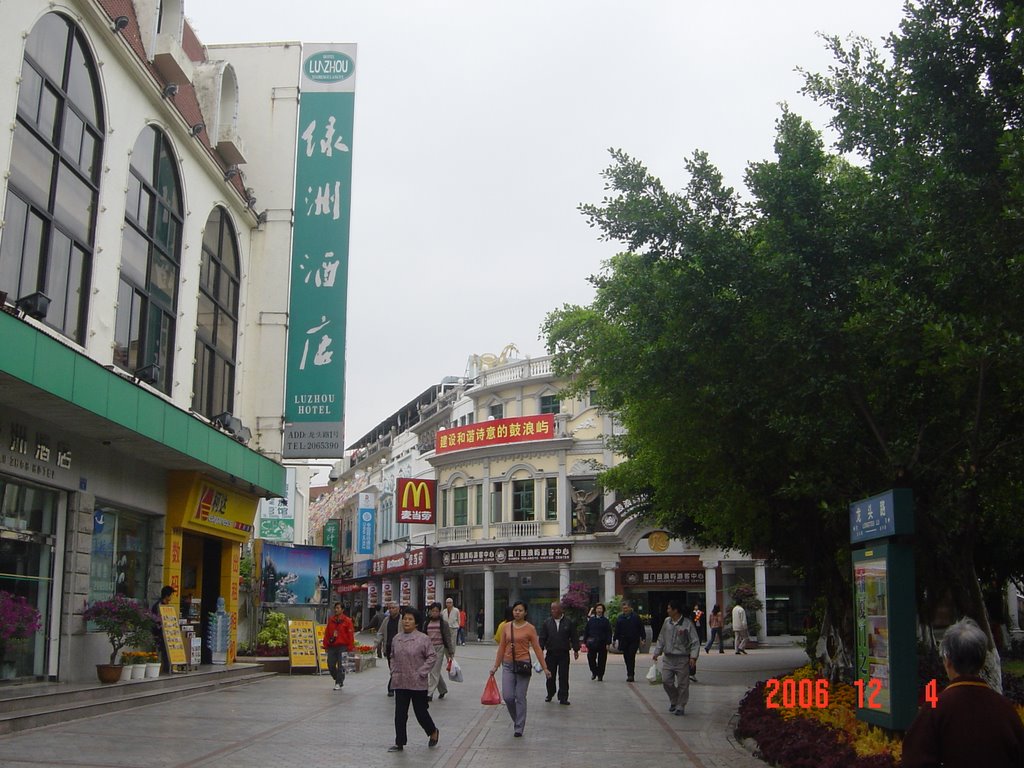
The "M" sign of the fast food shop looks like a pair of rabbit ears.

Gogo and I like to call it the "Rabbit Ears Shop".

Whilst I frequently saw these ears in the streets during my journey in Xiamen, the shops did not appear to be very popular as I could see a lot of empty seats inside.

We had a lunch at the Gulangyu shop. The price of the food was 25% cheaper than that in Hong Kong.

Unlike Gogo, I do not have any preference for the fast food. I enjoyed very much the food served in the local restaurants. Two thumbs up to the cooks in Xiamen!

[Links to Part 1 and Part 3]

Friday, December 01, 2006

Episode 50 - Fei Jia Shui

Gogo mentioned in his blog that he drank a lot of "Fei Jia Shui" at the BBQ gathering.

That's it!

He was very happy when he saw this big bottle in the street of Shanghai.

The photo was taken at Nanjing Road.

Sunday, September 10, 2006

Episode 29 - Gogo and his water melon


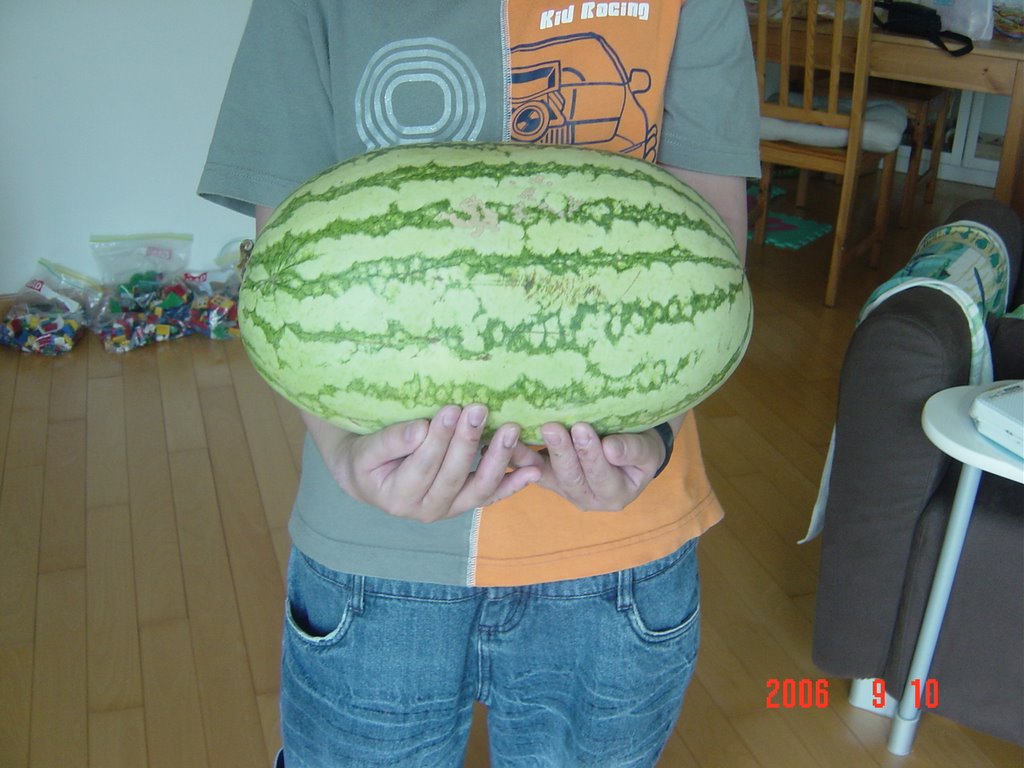
Gogo purchased this water melon from a supermarket earlier today.

The price was HK$24.9 for one regardless of its weight. Gogo therefore picked the largest one. The melon weighed 7.5 kg.

.


This variety of water melon is juicy, fresh, sweet and with little seeds.

Thursday, August 17, 2006

Episode 17 - Waterway at Tai O


Photo taken by Gogo Tsang

Waterway at Tai O

Tai O is a village in the Lantau Island of Hong Kong. The photo shows its traditional "Pang Uks" (stilt houses) along a waterway. People living in these Pang Uks usually make use of the waterway for transportation. Because of such waterway, Tai O is also known as the "Venice of Hong Kong".

Unlike the modernised Central District, Tai O preserves the atmosphere of a traditional fishermen's village. Apart from fresh sea food shops and restaurants, it has shops which sell traditional produce like salted fish and dried sea food.

The tourists can also enjoy "tea dumpling", a traditional steamed dumpling with leaf warping, in Tai O.

Nowadays, you can only find tea dumplings in the New Territories or Outlying Islands in Hong Kong. Furthermore, the art of cooking tea dumplings does not appear to have passed down to the young generation. The sellers (who are also the cooks) are usually old men or old ladies.

My taste buds (they are professional!) tell me that the tea dumplings at the old lady's stall near the bus station are the best in Tai O. The old lady uses wood and charcoal, instead of electricity, to heat the steam boiler.

(See Episode 14 for another Hong Kong attraction)