Showing posts with label Bridges. Show all posts

Sunday, July 08, 2007

Episode 130 - Along the River During the Qingming Festival


[The Rainbow Bridge and a closer-look of it: portion of the Qingming River as reproduced in the museum brochure]

My family visited the Hong Kong Museum of Art and saw the "Along the River During the Qingming Festival" (the "Qingming River") today.

The Qingming River is a painting of over 5 metres in length. It depicts in details what's happening in the Bian City and the outlying areas along the Bian River during a Qingming festival. It was drawn at the time of the Song Dynasty in ancient China.

The Qingming River exhibition is one of the hot events in town in celebration of the 10th anniversary of the Reunification of Hong Kong with China.

It is said that the Qingming River will only be available for public viewing once every 10 years. Further, it is the first time the painting is displayed in Hong Kong. Hence, the ticket office of the Museum is always line up with people.

My family have the Museum annual passes so we did not need to buy tickets. We arrived the Museum at 11 a.m. but were not able to view the painting immediately. As there were too many visitors, we only managed to get registered for a time slot at 4 pm.

In addition to the Qingming River, there are 15 great paintings being exhibited in another exhibition hall in the Museum. We took advantage of the time in between to visit these paintings and have a lunch as well.

As there are too many visitors, the viewing session in respect of the Qingming River is limited to 5 minutes for each visitor. We were only able to view the painting for one and a half round within these 5 minutes. To my and Judith's surprise, both Gogo and Chiu Yin were excited to see the painting.

I have seen a copy of another version of the Qingming River. Such version was an imitation drawn at the time of the Qing Dynasty. The Qing version is more colourful. However, there are a number of differences between the two. The major difference is the "Rainbow Bridge" (see above) which flies over the Bian River in the middle of the painting. The Song version features a wooden bridge but the Qing version features a stone bridge. Further, the positions and conditions of the boats near the bridge and the body languages of the various characters around make the Song version a more attractive piece of work.

Outside the viewing room is a large hall displaying detailed explanations on various portions of the painting to enable visitors to have a deeper understanding of this great artwork. The brochure provided by the Museum also gives a good briefing on the contents of and background information in relation to the painting.

The Museum did a very good job. Although the viewing time was limited, the arrangement was good and the staff were helpful.

We received a small souvenir before leaving the exhibition hall. It is a miniature scroll of the painting!

Friday, June 29, 2007

Episode 126 - Bridge of Love

These photos were taken at the Fishermen's Wharf at Danshui, Taipei.

Danshui is an old town in Taipei. If you take the subway at downtown Taipei, you will arrive here within half an hour's time. Danshui is the terminal station of the subway line so you will not miss the station.

The Fishermen's Wharf is not located at the town centre. However, it's worth taking a leisure walk in the Danshui Old Town, tasting the delicious local food before boarding a bus or a steamboat to the Fishermen's Wharf.

The Fishermen's Wharf features a beautiful white bridge and a long boardwalk (see photos) along the coastal line.

Whilst lovers like to walk along the boardwalk to enjoy the beautiful sunset of Danshui, the "Just Married" couples like to take photos on the white bridge.

Saturday, March 31, 2007

Episode 96 - The Snow Bridge

Another wonderful morning at Prague.

The previous day was a perfect sunny day. But when I woke up in the morning, I found that the city had turned into white overnight. I was delighted and rushed out of the hotel to enjoy another wonderful day.

This photo was taken at the Charles Bridge. It is a 13th Century bridge, linking the old town to the castle on the other side of the Vltava river. There are 30 baroque-styled statues erected along the bridge. Can you can see a crucifix statue on the left side of the bridge tower?

I visited the bridge in the late afternoon on the previous day. At that time the bridge was packed with people. Apart from visitors and souvenir sellers, there were a number of portrait drawers and street musicians - a big contrast to the quiet snow bridge.

I walked on the white carpet, following my footprints of the previous day to the Prague Castle again.

Thursday, March 15, 2007

Episode 88 - Departing from the Deities' Home

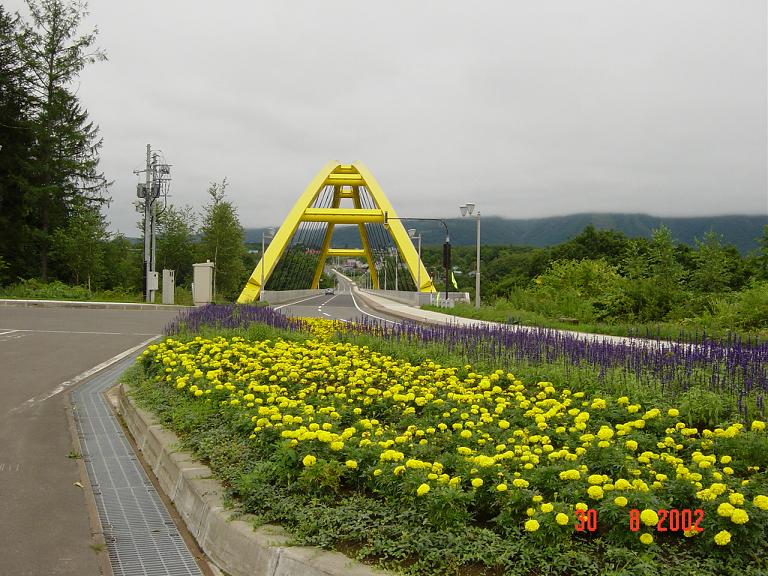
This is a road bridge at Niseko. I travelled by car in the surrounding areas in the summer of 2002. At that time, GPS was not a standard equipment for a rented car and I had to rely on a local map and road signs during my journey.

When I took this photo, I and my family were heading to Rusutsu, after 3 days' staying in Niseko. At the far side of the bridge is the road leading to the Panorama Line where you can go to Shinsennuma. Turning to the right side of the photo is the road leading to Rusutsu.

Rusutsu has a big amusement park - where Gogo wished to visit during the journey.

Following the road signs, we passed through the outskirt of the beautiful Mount Youtei and reached the amusement park at noon.

Monday, March 05, 2007

Episode 85 - Crossing the moon

This photo was taken at Arashiyama, Kyoto.

Arashiyama is at the outskirt of Kyoto and is accessible by trains or by buses. The photo shows the landmarks of this area: Mount Arashi, Katsura River and the Togetsu Bridge.

Apart from the river side as shown in the photo, other points of interests around the area include Tenryuji, a famous Zen temple, and the Bamboo Groves. To enjoy the beauty of the Hozu River at the upper stream and the surrounding valleys, you can take the Sagano Romantic Train from Arasiyama to Kameoka and return by a boat trip down the Hozu River and back to the Katsura River.

The Togetsu Bridge is a long semi-wooden bridge crosses the Katsura River. The beautiful Mount Arashi forms a dramatic backdrop to the bridge. It is an excellent place to view cherry blossoms.

Literally, Togetsu means "crossing the moon" - it is where you can appreciate the beauty of "Mirror Flower, Water Moon".

Friday, March 02, 2007

Episode 82 - Somewhere in time


This is the Bikan Area at Kurashiki.

The Japanese word "Bikan" means "beautiful". Walking into this area, visitors soon find themselves surrounded by a large number of traditional Japanese houses. These are 17th century merchant quarters and warehouses built for the storage of rice harvested in the surrounding localities.

Running through the area is a canal lined with willows. One feels like travelling back to the Edo period whilst walking across the stone bridge over the canal.

I first visited Kurashiki in 1986 on the recommendation of my Japanese friend and have revisited it twice thereafter.

Apart from the traditional houses, the Ivy Square and the Ohara Western Art Museum nearby are also spectacular.

Kurashiki is on the west of Okayama City and is easily accessible by train. The Bikan Area is 15 minutes' walk from the Kurashiki Station. Walking maps are available at The Tourists Information Centre.

Wednesday, February 28, 2007

Episode 80 - Bridge in Foggy City

This is the Nusamai Bridge at Kushiro, Hokkaido, Japan.

I travelled by car in Hokkaido in the 2003 summer and arrived at Kushiro on the fourth day of my journey. Kushiro is a city in the north eastern part of Hokkaido. After parking the car at the hotel, I decided to take a walk around instead of by car, as
the GPS system was not functioning smoothly inside a city with high rise buildings.

My hotel was situated near to the Nusamai Bridge and I took this picture on my way out.


It looks as if I took the photo at the evening time. In fact it was only around 4:30 p.m. in the afternoon. It was then very foggy and all the street lights were turned on. Hence, this evening feel photo.

The Nusamai Bridge is one of the 3 landmark bridges in Hokkaido. It was first built in 1889 and has been rebuilt for many times since then. The present one is the fifth generation and was completed in 1976.

On the other side of the river is a sea-food restaurant, in which I and my family enjoyed a yummy Hokkaido "long-legged" crab dinner that evening.

Friday, February 23, 2007

Episode 78 - Red Bridge, Green Tea

This photo was taken at Uji, Kyoto Prefecture, Japan.

Uji is located in the south of the Kyoto City. It is one of the cities along the Nara Line which runs to and fro Kyoto and Nara. I like to travel on this railway line as there are a number of points of interests along it. Usually, I will board the train at Kyoto Station in the morning and stop at Inari for one hour or so. I then board the train again and stop at Uji for a lunch break. I then board the train again to Nara and spend the whole afternoon there before returning to Kyoto.

The red bridge in the photo is situated near to the city centre and the various historic sites where the last episode of the great Japanese fictional work Tale of Genji was staged. The bridge flies over the Uji River and merges harmoniously with the surrounding mountains. If you visit Uji during Easter holidays, you will be able to see blooming sakuras along the river banks.

Next to the red bridge is a temple called
Byodoin. It is said that archaeologists dug up some important national treasures in the vicinity of the temple.

Uji is famous for tea. There are many tea shops along the street leading to the red bridge and Byodoin. I like to buy some tea here as souvenir for my relatives and friends. The shopkeepers are kind and hospitable to visitors. They will invite you to take a seat inside the shops and serve you with their famous green tea.

Apart from buying Japanese tea, my family used to stop at one of the cafes in the same street to have some delicious green tea ice-cream.

Sunday, December 17, 2006

Episode 56 - Danger, Not Danger


This photo was taken at the seaside near the Xiamen Hulishan Fortress.

The wording on the notice board means: "Dangerous bridge. People who have nothing to do with it keep away."

As you can see from the photo, a sampan is mooring at the floating board connected to the bridge. It is obvious that the bridge is being used for some purpose.

If it is dangerous, it is not fit for use. How come a related person can use it? Does the sampan belong to a related person? If the sampan owner did use the bridge, anything unusual happened?

Is this a hoax or a real danger?

I could not resist the temptation to step on the bridge.

I came home safely.

Sunday, November 26, 2006

Episode 48 - Bridging the Gap


Occupying the Centre (Part VII)

This is the famous Chapel bridge at Luzern, Switzerland.

A bridge is a structure that allows things to cross from one side to the other.

In order to control an opponent and to take over his centre in close quarter combat, a connection between the two bodies has to be established.

One of the advanced techniques in the Taiji martial art system is the setting up of a "bridge" between oneself and the opponent through body contact. Once a connection is made, the opponent loses his centre. The two bodies merge as one and the centre of the opponent dissolves. He who maintains the centre takes charge of the next step.

Another alternative is to hang oneself on the opponent and use the opponent's centre as the centre of the merged bodies. Whilst the centre appears to be staying outside of one's "own body", the connection enables extension of control from one's body to the opponent's body. Can you remember the dragonfly that stayed on the top of a flower bud (in Part I)? The centre of the flower bud is also the centre of the dragonfly.

One follow up question:

After a connection has been made, what is the "thing" that crosses the "bridge"?

He who has completed the training in "Standing" should know the answer.


(Links to Part I, Part II , Part III , Part IV , Part V and Part VI)