Thursday, March 22, 2007

Episode 90 - Clivia: flowering

I took this picture of my clivia this morning.

As you can see from the photo, a red flower is growing out from the leaves margin. There are a number of flower buds in the same shoot. I will post another photo a few days later.

The flower shoot of the clivia was held up by the leaves at first (see previous posting). After completion of the remedial work, the flower buds grow out rapidly.

This variety of clivia has short flower shoot. Some varieties have long flower stems and their flowers grow out at the top of the stems.

Sunday, March 18, 2007

Episode 89 - Arashiyama in the Rain

I took this photo at the Kameyama Park of Arashiyama, Kyoto, Japan in 1993.

You can see a stone monument with a Chinese poem engraved on it. The poem was written by the late Premier Zhou Enlai of China when he visited Japan in 1919. The stone craving is the calligraphy of Liao Chengzhi. The poem is called "Arashiyama in the rain":

【雨中嵐山】  周恩來

雨中二次遊嵐山
兩岸蒼松夾著幾株櫻
到盡處突見一山高
流出泉水綠如許
鏡石照人
瀟瀟雨霧濛濃
一線陽光穿雲出
愈見姣妍
人間的萬像真理
愈求愈糢糊
- 糢糊中偶然見著一點光明
真愈覺姣妍


Arashiyama in the Rain  Zhou Enlai

Visiting Arashiyama for the second time in the rain.
River banks line with pines and patch with blossoming cherries.
End of the road emerges a tall mountain,
with spring water running out so green.
Rocks in the river reflecting visitors' images.
In the foggy rain,
a ray of sunlight shines through a gap in the clouds.
Arashiyama becomes much more beautiful.
Like searching for the absolute truth in human world,
The more effort you put in, the more confused you become.
- once you see a light in such confusion,
You really feel the beauty of it.

[my translation]


I first visited Arashiyama in 1986. I had never heard of this place before when I arrived at Kyoto. I recall that I bought a one-day bus ticket and travelled along the tourist route as suggested by the ticket office. It was already in the late afternoon when the bus stopped at a station near Bridge Togetsu. I was deeply impressed by the beauty of this area and have since revisited it for many times. Apart from the cherry blossoms season (when Premier Zhou visited Arashiyama), I also like the red leaves season and the snow season.


Thursday, March 15, 2007

Episode 88 - Departing from the Deities' Home

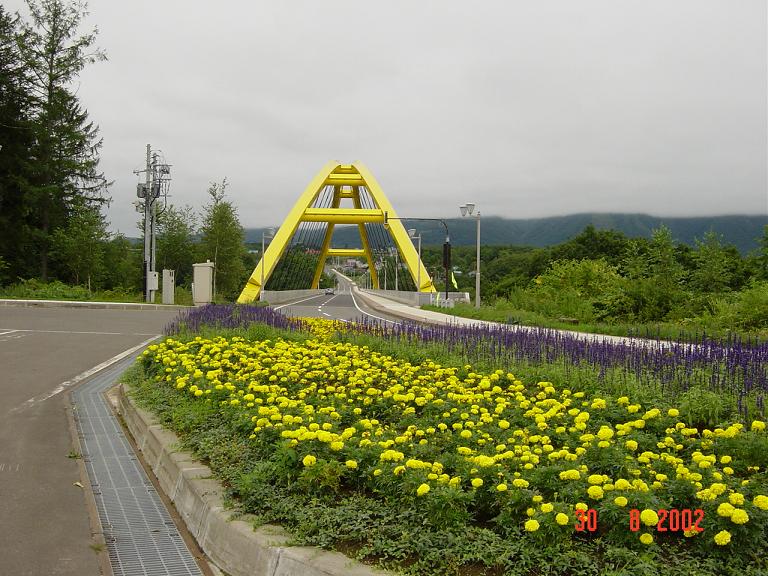
This is a road bridge at Niseko. I travelled by car in the surrounding areas in the summer of 2002. At that time, GPS was not a standard equipment for a rented car and I had to rely on a local map and road signs during my journey.

When I took this photo, I and my family were heading to Rusutsu, after 3 days' staying in Niseko. At the far side of the bridge is the road leading to the Panorama Line where you can go to Shinsennuma. Turning to the right side of the photo is the road leading to Rusutsu.

Rusutsu has a big amusement park - where Gogo wished to visit during the journey.

Following the road signs, we passed through the outskirt of the beautiful Mount Youtei and reached the amusement park at noon.

Wednesday, March 14, 2007

Episode 87 - Clivia in bud

A flower shoot is coming out from the clivia. This is the second time this clivia flowers.

In the past week, the flower shoot was held up by the leaves. In order to release the flower shoot I have added water, tied down the leaves on one side, and cut open a little bit of the base of the leaf next to the flower shoot. The remedial actions appear to be successful as I can see other flower buds coming up from the same position.

You can also see from the photo that the small leaf bud of the clivia has developed into a small plant on the left side. I decide to cut it out and move it to a new pot after the flowering season.

I will post another photo when the clivia blossoms.

Saturday, March 10, 2007

Episode 86 - The Art of Throwing


The basics of the art of throwing in Taiji can be illustrated by the ring children.

1. It involves the centre - the eye of the ring.
2. It involves circular movement - the outer ring.
3. It involves balancing - the turning babies.
4. It involves the joints - the folding arms, bodies and legs.
5. It involves the technique of Yin and Yang - the boy and the girl.
6. It should be used on solid ground - where the statue stands.

Comparing taiji with other schools with throwing applications, there is no big difference in the "forms" used. The difference lies in the way as to how an opponent is unbalanced before he is thrown.

Apart from Yin Yang Conversion, one of the techniques used in Taiji is the applying of a slight force on a critical joint of the opponent so that his centre of gravity is altered. The opponent can then be thrown without using strength. Many "beginners" are fascinated by such "magical touch".

Not relying on brutish force, such application technique should be supported by the body condition acquired through the basic trainings. Without the support of a natural body, this technique is only workable in demonstrations (for art appreciation) and not in a contest.

Applying a slight force on a critical joint of your opponent is the final touch before a throw. Prior to this, you have to slip (not break, hence, not brutish pushes or pulls) into the defensive ring of the opponent, attach to him, cross the bridge, take over the centre, and convert the Yin and Yang. These should be done in one go. In fact, once you convert the Yin and Yang, you can almost do anything on your opponent. The importance of the joint movement should not be over-emphasised.

In a real deal, no one will let you do the final touch freely on him as you can do so in a demonstration where your partner "cooperates" with you. Without the flexibility, sensitivity and power of a natural body, it is difficult to unbalance an opponent, in accordance with the taiji principles, in a real deal. It is therefore essential that a practitioner gets the basics correct from the very beginning of his training.

Not knowing the importance of and the rationales behind the basic trainings, many "beginners" (in the sense of knowledge, not seniority) find it difficult, if not impossible, to throw an opponent without using brutish force in a confronted situation. They end up doing weight lifting at the gym, condemning the Taiji Classic as a piece of nonsense.