 Occupying the Centre (Part IV)
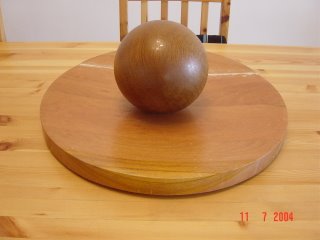
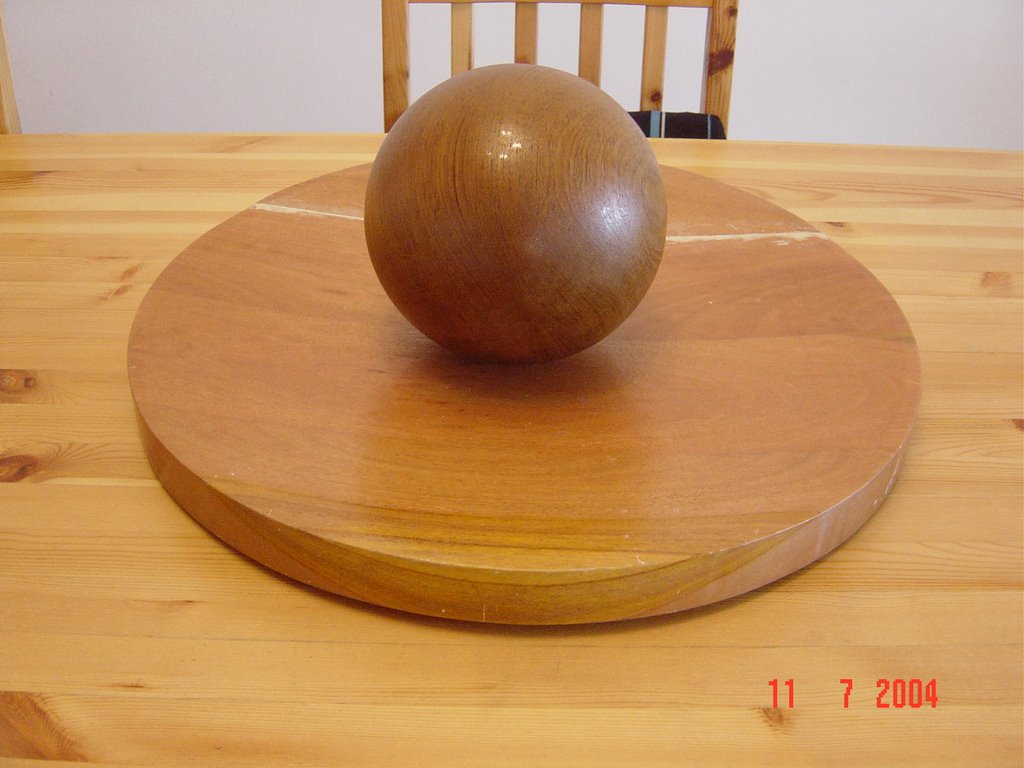
This is a taiji ball with its training table.
This taiji ball is made of solid wood and weighs 7 pounds. It is made from a single piece of wood. For advanced training, some martial artists use balls made of stone. Stone balls are heavy. The weight of a stone ball varys from 30 to 50 pounds. A high quality wooden ball is costly and is usually more expensive than a stone ball. A taiji ball made of combined wood is cheaper.
If a wooden ball is not readily available, a beginner can use a basket ball as a temporary substitution. However, one must note that a heavy ball is essential in developing the internal power. An alternative is to get a no holes bowling ball. Stone ball is not for beginners.
The training table has a concave surface. It was originally designed for the elderly to practise ball rolling exercise. The concave surface of the training table helps to control the movement of the taiji ball so that it will not roll outside the table area and drop onto the ground. The exercise is simple, you put the training table on a desk and the taiji ball on the training table. You then use your hand(s) (single or both) to roll the wooden ball, in a clockwise or anti-clockwise direction. It is said that the exercise assists the elderly to relax and increases the flexibility of their joints.
Martial art training exercises are a little bit complicated as there are various methods to roll the ball. A beginner can, however, take advantage of the concave surface of the training table for initial training. Following the ball's motion, a beginner learns how to do circular movements correctly. The training also assists a beginner to strengthen his torsos, and enhance the coordination of his mind and body.
After passing the initial training stage, you can discard the concave training table and roll the ball on the desk top direct. It requires greater skill to roll the taiji ball on a flat platform. A higher level of control is also required as it is easy to drop the ball onto the ground and hurt your feet or damage your floor (this also destroys the taiji ball). When rolling the ball, the practitioner should imagine that his internal energy is flowing out like water from his "dantin" to his hand and use the energy, instead of the arm's muscles, to roll the ball. It is not necessary to use the palm to roll the taiji ball. One contact point is sufficient to rotate the taiji ball if internal power is used. Through this training, a practitioner acquires the skill of "sticking" and develops his internal force with the assistance of the taiji ball. This builds up the foundation for utilisation of the Yin Yang Conversion technique.
It has to be noted that, it is not safe to roll a taiji ball on the desk without any precautionary measures. Some people put a towel on the desk but this will limit the rolling speed of the ball. Personally, I use a rectangular wooden plate with railing to do the training.
Apart from table top rolling, there are other rolling exercises such as rolling the ball on the wall or on edges of table. Use a basket ball for these exercises. In addition, there are some taiji ball standing exercises. A practitioner holds the taiji ball in his hands and performs various sets of specially designed circular movements. Through these exercises, a practitioner learns how to transmit internal force through circular movements, taking advantage of the centripetal force and the centrifugal force.
The training is not for muscles building. Never never treat the taiji ball training as a weight lifting exercise. The purpose of the training is to use external movements to activate internal movements - It is the internal things we want to train.
It is very difficult, if not impossible, to activate internal movements by practising empty-hand forms only. You need to ignite your internal energy before it can be developed into internal power.
The taiji ball is a catalyst.
Click links for
Part I,
Part II ,
Part III ,
Part V ,
Part VI and
Part VII)
.





 Posts
Posts

